Showing posts with label the Kastro. Show all posts

Almond Blossoms and a Brief History Lesson


Wendy took this photograph of Pedi recently while walking Sandouri.  For those of you who are unfamiliar with Symi, the bump in the middle of the photograph is the Kastro, where the |Knights of St John built a castle.  There was an even older fortification and church up there before that.  The old medieval town was clustered around its walls.  There wasn't much left of the castle  when the Germans used it as a munitions store during the Second World War and blew it up in the retreat, destroying many of the surrounding houses in the process.  The sprawl of buildings up the slopes of the Vigla to the left of the Kastro is a very old part of Chorio, around Agia Trianda church.  The original access to this ancient area of habitation was a footpath running from the back of Yialos, the neo-classical harbour, up behind the Kastro to Chorio.  It still exists and is referred to as the Kataraktis (Cataract) as it runs up the side of a deep gorge - part of the convergence of water courses that floods the harbour in winter downpours. The green belt between the sea and the houses is the Pedi valley, once a major fruit and wine producing area on the island.
Grey skies seem to be dominant at the moment as southerly winds bring haze and dust.  Yesterday's southerly was so strong there was a shipping ban and even Rhodes airport was closed for a while.  Things are a lot calmer today and it looks as though we have a hazy, possibly drizzly, mildly windy week ahead with temperatures around 18 degrees. 

Now that the summer ferry schedules have been released by Dodecanese Seaways and Blue Star Ferries people are seriously planning their holidays.  For flight tips, check Andy's travel blog.

Have a good week.

Regards,
Adriana

Read more...

July Postcards from Symi

Not a cloud in the sky.

The castle is long gone from the Kastro hill - all you can see are the remnants of the fortified walls. The castle was pretty much in a state of disrepair by the time the Germans were using it as a munitions store in the Second World War and when they blew it up, there wasn't much left.  The main damage was actually to the surrounding houses and this part of Chorio has been very slow to be rebuilt. The lanes are very narrow, often too narrow for donkeys, making reconstruction difficult and expensive and as the population is only about a tenth of what it was, there is little pressure to rebuild the more labyrinthine areas of Chorio.

Pedi bay at 7.30 a.m. today. Looking at that sparkling sea.

Those sunflowers are hanging on. That is the Vigla, the highest peak on Symi, in the background. When I first came here 23 years ago there were only two beacons up there - one to relay the TV signals from Rhodes and one to relay the radio signals likewise.  Now it is bristling with towers for the different mobile phone networks.  

If you have anything shipped to Symi, no matter how vehemently the removal firm or supplier will promise you door to door delivery, your goods will arrive on this yellow lorry which will park at a suitable spot in Yialos and then in Chorio.  Everyone comes to collect whatever they are expecting and somehow or other get it to their house.  Very few properties on Symi have close vehicle access so door to door deliveries are just not feasible, anymore so than dustbin men collecting from the houses.  

Yialos and Harani at 8 this morning. Suddenly things are looking busier.

There are even people on the Kali Strata.

One bougainvillea and a light breeze make confetti.

The motorboats are back. The  mooring men work out a system with all the sailing boats in one place, the motorboats in another and then all the gulets lined up in a row.   This way little boats don't get crushed by bigger ones and the hull shapes are compatible.  The mooring men work hard in the summer to keep everyone happy and fouled anchors to a minimum.

Water taxis ready for the beach.  Most of Symi's beaches can only be reached by sea and this is the most effective way of doing this.  When the temperature is 39 degrees the beach is a sensible decision. And yes, that is Michael's trusty 3 wheeler from the Hotel Fiona parked in the foreground.  He was enjoying a quick coffee and chat at Pachos.  That 3-wheeler must be 20 years old by now and he goes all over the island on it so it is something of a movable landmark if that makes any sense.

Read more...

A Walk Around the Kastro

Spot the almond tree!

I wonder who farmed those ancient terraces,  high on the barren slopes of the Vigla, and who planted that almond tree that is flowering so bravely in the gully.

While almond trees usually require human intervention, wild cyclamens appear wherever there is a little soil,  no matter how sparse.

Looking across at Mavrovouni in Yialos from the lane that goes around the Kastro, just beyond Lemonitissa. The sun was very bright yesterday, despite the haze, so the colours are a bit bleached.  Villa Iris and Spiti Grand Helene are on this hill, overlooking the town square and the head of the harbour.

 Looking down at the head of the harbour from a bit further along the Kastro road.  In the foreground from right to left, St John's church, the Petrides school and the basket ball pitch, the Garden studios and the Opera House hotel.  In the middle, from right to left, the  customs house, bridge and town square with Mavrovouni behind, Iapetos hotel and the road up to Ellikoni cemetery and the helipad. This is also the top access to Mavrovouni. The area of dark trees behind is the Drakounda valley. A foot path goes from there down to Nimborio bay which can just be glimpsed. On the far right you can just see Evangelismos church overlooking Harani with the island and monastery of Nimos behind. The purple hills in the background are the Datca peninsula in Turkey.

A closer view of St John's church, the Petrides school and the town square with Mavrovouni behind.

One of several churches of varying sizes and degrees of importance that crown the circumference of the Kastro.

One of the most interesting roofs in Chorio.

An immaculately maintained door in Chorio.  It is actually made of steel but as it has been carefully looked after it has not rusted through as has happened to may similar doors on the island.

Looking towards the windmills and Pedi bay from the Kastro road.  That is a solar water heater on the left. The diagonal row of houses running parallel to it marks the vehicle short cut into the centre of Chorio. Most of Chorio is only accessible on foot  or by scooter as the lanes are too narrow with intermittent steps to permit vehicles.  As Symi is so steep, there was never a tradition for horse-drawn vehicles and carts on the island so the houses in Chorio are very tightly packed and the lanes evolved for pedestrian traffic only.

This large open space is the village square in Chorio.  Fringed by houses and ruins on three sides, the fourth side is a steep set of steps, now fenced off, dropping onto the lane that turns into the Kali Strata. This is the main shopping street in Chorio and is where you will find traditional tavernas, cafes, bars, bakeries, the butcher and other shops in a long line that terminates in steps at one end and the local junior school at the other.

The Olive Tree like many other cafes and restaurants on the island, is closed for the winter. This cat is taking advantage of the peace and quite to relax on the top terrace.

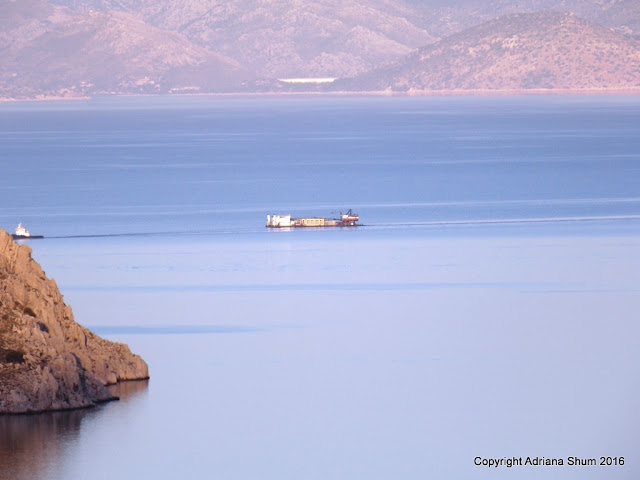
A tug towing another floating crane platform from Rhodes to Yialos for the new commercial harbour in Yialos. That is Turkey in the background, in the vicinity of Bozburun and that white stripe is the roof of a huge boatshed where boats are built for the foreign market.
After the blustery squalls and dust of Monday and the weekend, the weather has warmed up to abnormal temperatures for the time of year and Tuesday was absolutely calm.  It was about 28 degrees yesterday at midday - this time last year it was 10!  There is no real rain expected although once again we have a windy weekend ahead.  Temperatures are expected to settle around 13-18 degrees for the next week.  Apparently we have a 10% chance of 1 mm of rain but as that is likely to be more red Saharan sand than water it is unlikely to improve the current drought conditions and doesn't really count as rain.

As yesterday was the first fine calm and relatively clear day in ages I took my camera for a walk around the Kastro in Chorio. There isn't much left of the medieval Kastro itself as it was already fairly tumbled down when the Germans destroyed it during the Second World War but the lane that runs around the Kastro, from the back of the Chorio square to the oldest part of Chorio at the top of the Kataraktis, the old donkey path that predates the Kali Strata by over 1000 years, offers some lovely aerial views of the harbour.  The reason why the swimming pool at Iapetos Hotel, the only hotel on the island with a pool, is undercover is to avoid spoiling this view from above.

I hope you enjoy the pictures and, if you are a newcomer to Symi, that they give you an understanding of just how steep the island is.

Have a good week.

Regards,
Adriana


Read more...

The Kastro, the Kali Strata and a Cat

All that is left of the Castle the Knights built on Symi is a few remnants of walls.  The rest was destroyed when the Germans used the Kastro as a munitions store during the Second World War and blew it up during their retreat. This is why so many properties in the immediate vicinity of the Kastro are still in ruins today.  There are three churches built within in the walls of the ruined Kastro, not counting the one you can see on the right which is at the base of the access ramp.

A typical neo-classical Symi double storey on one of the access lanes to the Kali Strata.  The vine provides shade and privacy for outdoor living in the summer.  Instead of wasting space with internal stairs, the downstairs has a separate entrance from the lower lane.  There really is no such thing as a level building plot on Symi and all the houses are adapted to fit the extreme steepness of the landscape.  Symi is famous for steps, steps and yet more steps.

This three storey mansion overlooking the Kali Strata and the harbour is exactly 100 years old according to the date in the plaster on its pediment.

Today's Symi cat, snoozing on the bamboo above the Chrysalis boutique.  Note the overhanging eaves on this building.  This is characteristic of the Ottoman Empire and is one of the few buildings left on Symi that still reveals its Turkish connections. The Ottoman Empire lasted 400 years and during that time Symi was relatively prosperous, providing the Sultan with fast ships (built in the boatyards of Yialos - where the town square car park is now - and Harani) and sponges for the beautiful women of the harem.  Apparently they used the small ones, soaked in vinegar, as a rudimentary form of contraception.

A convergence of lanes at the bottom of the Kali Strata.  This was taken early in the morning, on my way to work, but in the evenings this area is humming with activity.

How to find the Kali Strata.  Look for the blue steps in the harbour and then take the left fork past the carpenter's shop. The ones that go up next to the Silk boutique are a diversion and will only take you to some ruins.  

Yachts milling about in the Meltemi breeze in Yialos this morning. The wind is bringing some welcome coolness to Symi this summer.  You can watch this view in real time with our webcam as this is the view from the Symi Visitor Accommodation office balcony.

The colourful chandlery at the bottom of the stairs to our office.  Dino sells an astonishing array of goods, including brass door knockers, goat bells and agricultural implements in addition to fishing rods, flags and yacht chandlery.

Lemonitissa church looking down on the town from the Kastro.  At this angle, viewed from the side balcony of our office in Yialos, Lemonitissa studio and apartment are masked by the trees to the right of the church.
The Meltemi, the prevailing wind in the Aegean, seems to have found us this year and we are enjoying some very welcome breezes.

We are now very busy as July is high season on Symi and there is a lot of coming and going, not to mention last minute bookings and this morning I actually received an email from someone who is wanting to plan their holiday around Easter 2016.  Now that is what I call forward planning!

Have a good week.

Regards,
Adriana

Read more...

About this Blog

I sailed into Panormitis Bay, Symi, by chance one windy July day in 1993 and have been here ever since. The locals tell me that this is one of the miracles of St Michael of Panormitis. A BA graduate with majors in English, Philosophy and Classical Civilisation, the idea of living in what is to all intents and purposes an archaeological site appeals to me. Not as small as Kastellorizo, not as touristy as Rhodes, Symi is just the right size. I live on a small holding which my husband and I have reclaimed from a ruin of over-grazing and neglect and turned into a small oasis over the course of the past 22 years. I also work part-time for Symi Visitor Accommodation, helping independent travellers discover and enjoy Symi's simple pleasures for themselves.

This page is kindly sponsored by Wendy Wilcox, Symi Visitor Accommodation.


Adriana Shum

Copyright (c) 2001-2017 Adriana Shum.


All Rights Reserved.

Keep in Touch with Symi