Showing posts with label Chorio. Show all posts

Symi - An Authentic Greek Island Experience

The glamour yachts are back.  We don't see as many huge megayachts as we used to but there is evidently still  money around, judging by this line up earlier in the week

A cat-nap

It is not all gin palaces and 'stink boats'.  We do see occasional sailing yachts like this one in Yialos.

Yes, this is Symi.  If you go up the mountain you enter a different world.  One of ancient forests, orchards and olive groves, mountain chapels and tumble-down terraces.

Cats and chickens living in peaceful co-existence on a corner in Lieni, an area on the top edge of the Pedi valley.

The voluptuously extravagant flowers of the wild caper bushes are a well-kept secret, only visible to early risers.  The tiny buds form in the evening, swelling over night and bursting into bloom at dawn, only to shrivel away in the morning heat.  The Greeks use almost every part of the caper plant, pickling and brining not just the immature flower buds but also the tender leaf tips and the seed pods.

A Symi scarecrow.

Blue and white.  The colonnade is part of Giorgio and Maria's taverna, a Symi landmark since the 1970s and still going strong, although the eponymous Giorgio and his wife have long since departed this earth.

The last gasp of the Kali Strata steps. The Olive Tree cafe is screened by the verdant garden on the left. Giorgio's taverna is the blue sign at the top centre.  There is a very charming small boutique selling artisanal sandals and other items immediately opposite the taverna entrance.  A bit higher up you will find the Rainbow bar and Boulmas/Lefteris Kafeneion, a butcher, a baker and various other shops.

The  blue studios at the Hotel Fiona in Chorio.

The traditional herb shop, just down from the Olive Tree at the top of the Kali Strata. They also sell Greek coffee and other ethnic delicacies.

Free range on the Kali Strata. There is no real division between town and country on Symi and many Symiots keep a small flock of hens and a rooster to supply the family with eggs and the occasional bird for the pot.

The lanes of Yialos abound with shops and boutiques to suit every budget and taste.  Symi has quite a reputation for its excellent shopping opportunities in the summer and you will find far better and more interesting items for sale here than in Rhodes Old Town.

Symi's new fresh fish shop, next to the Georgina's Market in Yialos.

Day visitors from Rhodes enjoying a seafood lunch at one of the traditional tavernas in Yialos.

Not all of the lanes are busy and bustling. Some of them are peaceful oases.
Symi is getting busier as July progresses.  Hot sunny days by the sea merge into warm summer evenings in the bars and tavernas.  Visitors grow browner by the day.  Most of Symi's beaches can only be reached by water taxis operating out of Yialos and Pedi.  Others can be reached on foot in Nimborio and Pedi and there is also a mini-bus service several times a week to take people across the island to Toli Bay for the day or down to Marathounda, the tiny seaside village near Panormitis.  On Symi you can go to a different beach or bay everyday, or find your favourite and visit it time after time. The choice is yours.

Symi is very popular with single travelers.  An advantage of staying on an island where visitors stay among the locals is that everyone quickly knows everyone else.  The locals eat at the same tavernas as the tourists, visitors travel on the same bus as the locals and shop in the same shops.  First names are quickly exchanged and no one remains a stranger for long. This is why people keep coming back, year after year, visiting friends and making new ones.  Symi is a totally authentic and unique Greek island experience.

There is still quite a lot of accommodation available on the island for this summer if you have flexibility with your dates.  Have a look at our travel blog to see what flight options connect with the ferries to Symi and drop us an email.

Have a good week!

Regards,
Adriana


Read more...

On a Cold Friday in December

Over the hills and far away... my camera  is not quite good enough to pick it up but there is snow on a mountain peak just to the right of the highest peak visible on the left on the Turkish coast.

The northerly gales  have brought some extraordinary cloud formations.

These are the skies that summer visitors to Symi seldom see.

The bottom of the Kali Strata.  That cardboard box is serving a useful purpose.

I am not sure how many Symi cats are living in there but I didn't want to disturb them on a bitterly cold morning to find out!

Still life with yellow plastic tablecloth.

Potatoes!

In a garden down in Pedi

A classical face on a crumbling house in Chorio.

Christmas kitsch in Chorio.  Yes, that is a lifesize replica Santa playing a plastic saxophone!
The idyll is over.  Heavy rain and thunderstorms on Tuesday turned into plunging temperatures and gale force northerly winds by Thursday and Symi is in single figures today.  Showers and  more thunderstorms are forecast for the weekend so unfortunately we will have to leave the webcam unplugged when we are not in the office.

There are very few people about on the streets as there isn't much to do on Symi at this time of the year.  A  handful of men are in those coffee shops that are still open but that is about it.  Everyone is tucked up indoors out of the wind and that is what I will be doing soon myself!

Have a good weekend.

Regards,
Adriana


Read more...

From Yialos to the Heights of Chorio

Yialos, Symi's famous natural amphitheatre harbour is lined with tiers of beautiful 19th century neo-classical houses.  Most have now been restored by private owners.  These houses were built during the island's most prosperous period, in the late 19th century, when sponge diving and ship building brought wealth to the island and there were estimated to be around 20 000 inhabitants.  

Symi's old town is Chorio, the upper town.  Although the first settlement on the island, back in Homeric times, was believed to be at Nimborio, a bay where the flat-bottomed boats of the time could be dragged up the beaches to safety in the winter, the inhabitants of Symi soon sought out the defensibility of the high ground and the main settlement was formed around the Kastro where the castle was subsequently built.  The white building with the green doors at the end of the lane in this photograph is the museum which has been undergoing renovation and restoration courtesy of an EU grant for a number of years.  Now all we need is funding to pay staff to keep it open so that visitors can enjoy the  many artifacts housed there.  By the way, the museum building was donated to the town by the Farmakides family and was apparently the Austro-Hungarian embassy on Symi in the nineteenth century.  That gives you an idea of just how important Symi was then.  There is a story that the popular Austrian Empress, Sissi, was entertained there on her travels in the Aegean. The terracotta building on the right is a privately owned village house that was restored with great care a few years ago.

Much of the old town was damaged when the castle blew up in the Second World War, leaving behind some intriguing ruins. There are many such tunnels as on such steep terrain level ground for building was in short supply and houses often straddled the narrow lanes.

Bathrooms are a recent innovation and as Symi houses are small they are built wherever space can be found, which may not necessarily be indoors. In the case of this house, they have gone one further and built it in their garden across the lane.  It is not very clear in this photograph but this bathroom was built with a shallow brick cistern on the roof.  Water could be pumped up to this, providing gravity feed for a shower below so no electricity was needed to shower.  If you stand in a basin when you shower the water can then be used to flush the lavatory.  Symi doesn't have a proper sewage treatment plant and most houses still have vothras - basic stone soak pits, not unlike septic tanks but built out of unplastered stone so that the liquid can seep away and feed nearby trees. This is one of the reasons why one never ever puts paper - or anything else - down a Symi loo - the paper blocks up the spaces between the stones and prevents the drainage essential for the vothra to function, causing problems you don't even want to think about here!

Scaffolding around the bell tower of Agios Thanassis, one of the many parish churches in upper Chorio.

This old shop in the top of Chorio has always intrigued me with its carved lintel and enigmatic carved faces.  Whatever it was, it must have been quite posh for so much expense to have gone into the  dressed stone facade.

The approach to Stavros church, another one of the upper Chorio churches. This was once one of the busiest neighbourhoods of the old town and there are the remnants of many old shops and cafes up there.  There was even a tannery and a dairy.

Looking across from Stavros church towards the Kastro.  If you look carefully you can see the bulges of remnants of the old castle walls. This neighbourhood is about 10 minutes walk in any direction to the nearest vehicle access so very quiet - if you exclude all the bells!

Read more...

A Walk Around the Kastro

Spot the almond tree!

I wonder who farmed those ancient terraces,  high on the barren slopes of the Vigla, and who planted that almond tree that is flowering so bravely in the gully.

While almond trees usually require human intervention, wild cyclamens appear wherever there is a little soil,  no matter how sparse.

Looking across at Mavrovouni in Yialos from the lane that goes around the Kastro, just beyond Lemonitissa. The sun was very bright yesterday, despite the haze, so the colours are a bit bleached.  Villa Iris and Spiti Grand Helene are on this hill, overlooking the town square and the head of the harbour.

 Looking down at the head of the harbour from a bit further along the Kastro road.  In the foreground from right to left, St John's church, the Petrides school and the basket ball pitch, the Garden studios and the Opera House hotel.  In the middle, from right to left, the  customs house, bridge and town square with Mavrovouni behind, Iapetos hotel and the road up to Ellikoni cemetery and the helipad. This is also the top access to Mavrovouni. The area of dark trees behind is the Drakounda valley. A foot path goes from there down to Nimborio bay which can just be glimpsed. On the far right you can just see Evangelismos church overlooking Harani with the island and monastery of Nimos behind. The purple hills in the background are the Datca peninsula in Turkey.

A closer view of St John's church, the Petrides school and the town square with Mavrovouni behind.

One of several churches of varying sizes and degrees of importance that crown the circumference of the Kastro.

One of the most interesting roofs in Chorio.

An immaculately maintained door in Chorio.  It is actually made of steel but as it has been carefully looked after it has not rusted through as has happened to may similar doors on the island.

Looking towards the windmills and Pedi bay from the Kastro road.  That is a solar water heater on the left. The diagonal row of houses running parallel to it marks the vehicle short cut into the centre of Chorio. Most of Chorio is only accessible on foot  or by scooter as the lanes are too narrow with intermittent steps to permit vehicles.  As Symi is so steep, there was never a tradition for horse-drawn vehicles and carts on the island so the houses in Chorio are very tightly packed and the lanes evolved for pedestrian traffic only.

This large open space is the village square in Chorio.  Fringed by houses and ruins on three sides, the fourth side is a steep set of steps, now fenced off, dropping onto the lane that turns into the Kali Strata. This is the main shopping street in Chorio and is where you will find traditional tavernas, cafes, bars, bakeries, the butcher and other shops in a long line that terminates in steps at one end and the local junior school at the other.

The Olive Tree like many other cafes and restaurants on the island, is closed for the winter. This cat is taking advantage of the peace and quite to relax on the top terrace.

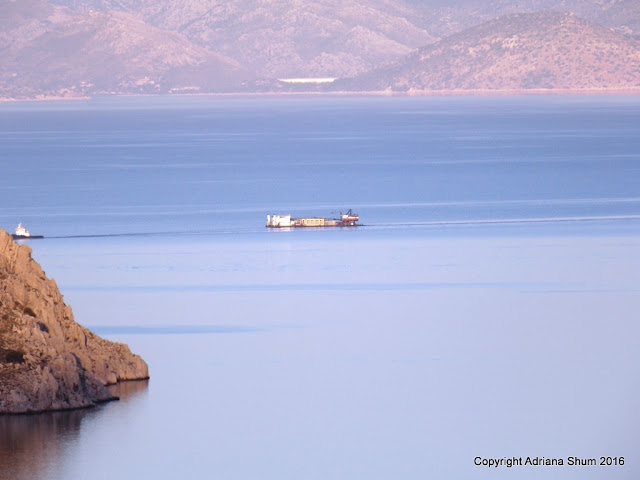
A tug towing another floating crane platform from Rhodes to Yialos for the new commercial harbour in Yialos. That is Turkey in the background, in the vicinity of Bozburun and that white stripe is the roof of a huge boatshed where boats are built for the foreign market.
After the blustery squalls and dust of Monday and the weekend, the weather has warmed up to abnormal temperatures for the time of year and Tuesday was absolutely calm.  It was about 28 degrees yesterday at midday - this time last year it was 10!  There is no real rain expected although once again we have a windy weekend ahead.  Temperatures are expected to settle around 13-18 degrees for the next week.  Apparently we have a 10% chance of 1 mm of rain but as that is likely to be more red Saharan sand than water it is unlikely to improve the current drought conditions and doesn't really count as rain.

As yesterday was the first fine calm and relatively clear day in ages I took my camera for a walk around the Kastro in Chorio. There isn't much left of the medieval Kastro itself as it was already fairly tumbled down when the Germans destroyed it during the Second World War but the lane that runs around the Kastro, from the back of the Chorio square to the oldest part of Chorio at the top of the Kataraktis, the old donkey path that predates the Kali Strata by over 1000 years, offers some lovely aerial views of the harbour.  The reason why the swimming pool at Iapetos Hotel, the only hotel on the island with a pool, is undercover is to avoid spoiling this view from above.

I hope you enjoy the pictures and, if you are a newcomer to Symi, that they give you an understanding of just how steep the island is.

Have a good week.

Regards,
Adriana


Read more...

Up in Chorio

The row of traditional cafes and tavernas adjoining the Syllogos Square in Chorio. This is the main square and meeting point in Chorio and a popular venue for events such as the Symi Shrimp Festival.

This mansion on the square is in the process of being restored.  If you ever go past and the door is open, glimpse inside as it has a very imposing staircase.  Proper internal staircases are unusual in Symi houses.

The main shopping street at the top of the Kali Strata, running from the Syllogos Square up towards upper Chorio.  Here you will find a baker, a butcher, a dress shop, a shoe shop, a gyros bar, a taverna, a supermarket, a toy shop...

The upper stretch of the Kali Strata from the view point at the corner, looking up towards the Syllogos Square.  On this stretch you will find the Symi Dream shop and Gallery, a shop selling herbs and Greek coffee, the Olive Tree cafe, a boutique and a flower shop.

Pomegranates and an interesting pediment in Chorio, in a lane near the bus stop/kiosk/clinic.

Birds on a lintel on the Kali Strata.

We see all sorts of boats in Yialos. The two blue tugs, one large, one small, are part of the harbour construction project. The white one appears to have been converted for leisure use as it has a covered after deck with dining table and chairs.

Reflections in Yialos.
The Meltemi has been and gone, replaced by high humidity and oppressive heat for a day or two. The temperature is in the low forties today and everyone with any sense is on the beach.  Due to its natural amphitheatre shape Yialos really traps the heat at this time of the year.  Chorio and Pedi are much cooler and airier in August, not to mention quieter.  It is not for nothing that the majority of the locals live up in Chorio.  In another couple of weeks the worst of the heat will be over and the golden days of September will be upon us.  The nights are already perceptibly longer and the supermoon this weekend was spectacular.

Friday is a religious and bank holiday in Greece and this week is the busiest of the year as so many people take their holidays at this time.  All of our houses and apartments are full now and anyone who arrives on Symi without prebooked accommodation may well find themselves in trouble.  Symi was never the sort of place really where people met the boats advertising rooms to let on bits of cardboard and with the enforced legislation now making it very difficult and expensive for locals to comply with the bureaucracy required to let out rooms, the informal budget sector has completely disappeared.  As the hotels on the island are small they fill up quickly and the majority of the accommodation is in restored traditional houses within the community so the supply of beds is limited.  Those in the know book well ahead, often a year in advance to be sure of getting the house they want.  We will be open for booking for 2015 in October if you would like to be sure of booking your dream holiday on Symi next year.

Have a good week.

Regards,
Adriana

Read more...

About this Blog

I sailed into Panormitis Bay, Symi, by chance one windy July day in 1993 and have been here ever since. The locals tell me that this is one of the miracles of St Michael of Panormitis. A BA graduate with majors in English, Philosophy and Classical Civilisation, the idea of living in what is to all intents and purposes an archaeological site appeals to me. Not as small as Kastellorizo, not as touristy as Rhodes, Symi is just the right size. I live on a small holding which my husband and I have reclaimed from a ruin of over-grazing and neglect and turned into a small oasis over the course of the past 22 years. I also work part-time for Symi Visitor Accommodation, helping independent travellers discover and enjoy Symi's simple pleasures for themselves.

This page is kindly sponsored by Wendy Wilcox, Symi Visitor Accommodation.


Adriana Shum

Copyright (c) 2001-2017 Adriana Shum.


All Rights Reserved.

Keep in Touch with Symi